
South Carolina Busted Mugshots
A booking photo shows a face at intake. The agency opens a custody record too. That record can be corrected, withheld, sealed, or destroyed later, depending on rules tied to the case.
Sheriffs and county detention centers run local bookings. Each one sets its own roster scope. The South Carolina Department of Corrections (SCDC) keeps a separate photo search for people held in state prison after sentencing. Match the source to the custody stage, or the record may sit with another agency.
South Carolina FOIA can cover a photo held by a public body. Counties face no duty to post images online. Exemptions and local policy shape access, and someone released from custody may drop off a live roster while the agency keeps an older record.
South Carolina Booking Record Fields
First figure out which system made the record you want. A county booking sheet documents local intake and custody. An SCDC profile covers a person sentenced to state prison. County portals differ by vendor. One agency may display only part of its files.
| Record field or view | What the statewide research supports |
|---|---|
| County custody status | County portals may separate current confinement from admissions and releases. A release view is not proof of the final court result. |
| Name and search key | Name search is common; some portals also accept booking or inmate identifiers. Use the live county screen to see required fields. |
| Dates and agency | Several county views support booking or release dates, date ranges, and arresting agency. The available filters vary by county. |
| Charge or held-for text | Some interfaces display charge or held-for fields. These are charges or custody labels at a point in time, not a disposition. |
| Booking photograph | Some county interfaces expose a photo field; others do not affirm a public image. Missing online photos do not prove no photo exists. |
| SCDC profile and photo | SCDC’s public search has photos and public inmate information for its covered prison population. Its search supports name, SCDC number, SID, and phonetic name lookup. |
SCDC's search lists sentenced people now in state prison. Its data reflects midnight the prior day. That makes it a custody tool, not an arrest log. County rosters work differently. Some show current custody. Others list recent bookings or releases, or a limited window. An "admit" entry marks intake; a "release" entry marks a custody change. Confirm identity with official details rather than a third-party caption alone.
Request South Carolina Booking Records
Some counties offer no public roster. Others remove people once released. In those cases, ask the record custodian directly. South Carolina FOIA allows inspection, copying, or electronic delivery of nonexempt records. An agency need not create a record it never kept. It may charge reasonable actual costs for search, retrieval, redaction, and copying, and it may require a deposit of up to one quarter of the estimate.
- Identify the county or agency that arrested, booked, or held the person. Separate the arresting agency from the detention center if they are different.
- Ask for a specific item, such as a booking sheet, arrest report, or booking photograph. Include a name, booking number if known, date or short date range, and the preferred electronic format.
- Send the request to that agency’s records custodian under South Carolina FOIA. Ask the agency to identify any fee before work begins.
- Track the statutory response dates. The agency generally makes an access decision within 10 business days, or 20 business days for a record more than 24 months old. If granted, production is generally due within 30 calendar days after the decision, or 35 days for an older record, subject to a lawful deposit.
Deadlines do not promise release. A privacy, juvenile, or law-enforcement exemption can block access, and a deposit or scope dispute can delay a request. For jail information, § 30-4-30(D) makes certain records identifying people confined during the prior three months available for in-person review during operations, unless an exemption applies. It is an access route, not a photo page.
SCDC holds its own records. Contact its FOIA office and describe the item sought. The public locator may not list a former offender or a document outside its display. Route your ask correctly. A county jail cannot produce an SCDC profile, and SCDC cannot produce a county booking sheet.
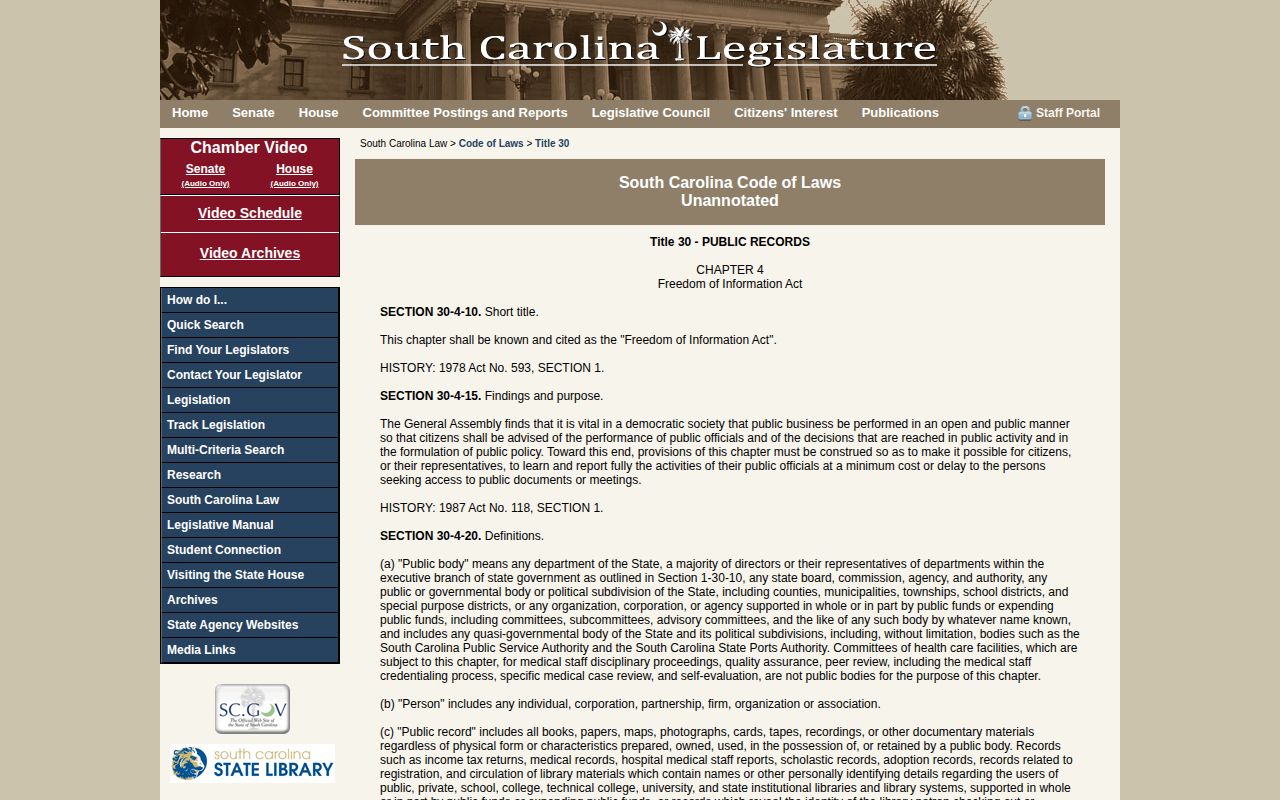
The South Carolina FOIA text sets the rules. It covers definitions, deadlines, and access limits for every request.
Note: South Carolina FOIA does not set one statewide mugshot copy fee, so ask the record custodian for the estimate before agreeing to costs.
South Carolina Busted Mugshot Laws
South Carolina leaves posting decisions to each sheriff. No law requires booking photos to go online. Section 30-4-20(c) counts photographs as public records. Sections 30-4-30 and 30-4-40 set the access rules, costs, and exemptions.
Section 17-1-60 protects people after a case ends. Covered publishers cannot charge for certain qualifying corrections or removals. A discharge, dismissal, expungement, or not-guilty result triggers the right. The person sends a certified-mail request with their name, arrest date, arresting agency, post URL, and certified proof of the outcome. The publisher must remove the record free within 30 days. A plea to a lesser or different offense earns a free revision within 30 days.
The current South Carolina Code has the full rule. It controls the procedure, not a third-party page.
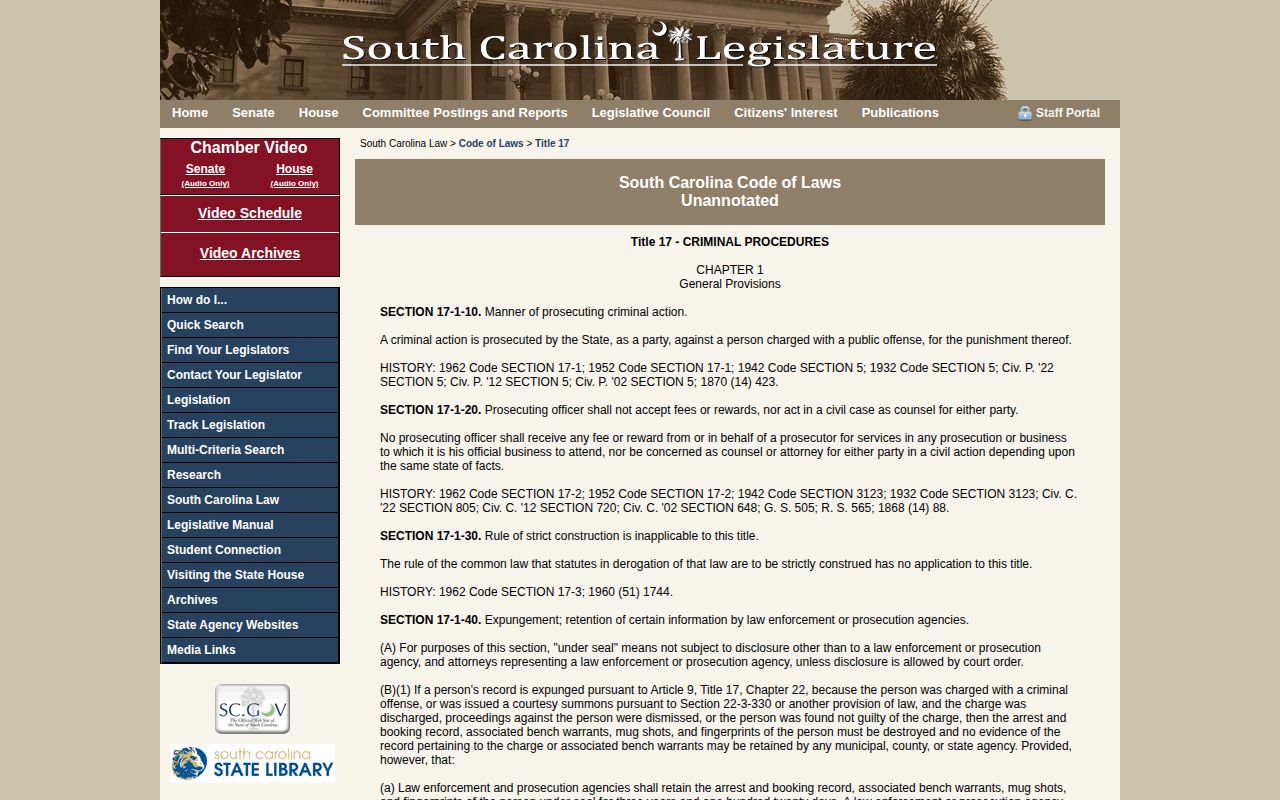
The publishing statute carves out room for news outlets, history books, and entertainment works. That exception matters most. The 2016 legislative record supplies background on the debate, nothing more. South Carolina also keeps most juvenile files closed. Youth court and law-enforcement records are confidential. Releasing a child's name or photo is restricted by law. A private webpage cannot undo that. Under § 17-1-40, a qualifying expungement order destroys arrest and booking records. Mugshots and fingerprints go too, apart from narrow sealed-retention exceptions. Section 17-22-950 gives qualifying summary-court charges 30 days. That window runs to their removal from internet-based public records after disposition. Still, no rule wipes every private copy or search result at once.
Note: Agency destruction, a publisher’s correction duty, and search-engine updating are separate steps with different triggers.
Find South Carolina Busted Mugshots
Start with the custody stage. The court file shows the outcome afterward. The County Directory routes each county to its local roster details, and where no search exists, ask the record custodian directly.
- Start with the county where the arrest and booking occurred, not just the city where the person lives. If the county is unclear, check the arresting agency and the court county.
- Open that county’s official detention or sheriff portal. Search the name, then use date or booking filters if offered. Read the portal’s own disclaimer and photo policy.
- If the person was released, check a recent-release view where the county offers one. A live custody roster may drop the person after release even though an agency record still exists.
- If the person is sentenced and incarcerated in state prison, use SCDC’s public offender search, not a county booking list.
- Look up the case in the state court system to see a hearing or disposition. If there is no public roster or the item is missing, request the record from the office that created it.
South Carolina runs no statewide booking feed. Every directory link opens its own county system. Keep in mind the arresting city. The detention county and the court may all sit in different places. For public-court context, the South Carolina Court Roster Search links county and city court rosters. Separate routes there serve Charleston and Greenville. The state trial-court portal stands apart from it. Both tools want a browser that accepts the site's scripts and cookies. A page that will not load tells you nothing about a case.
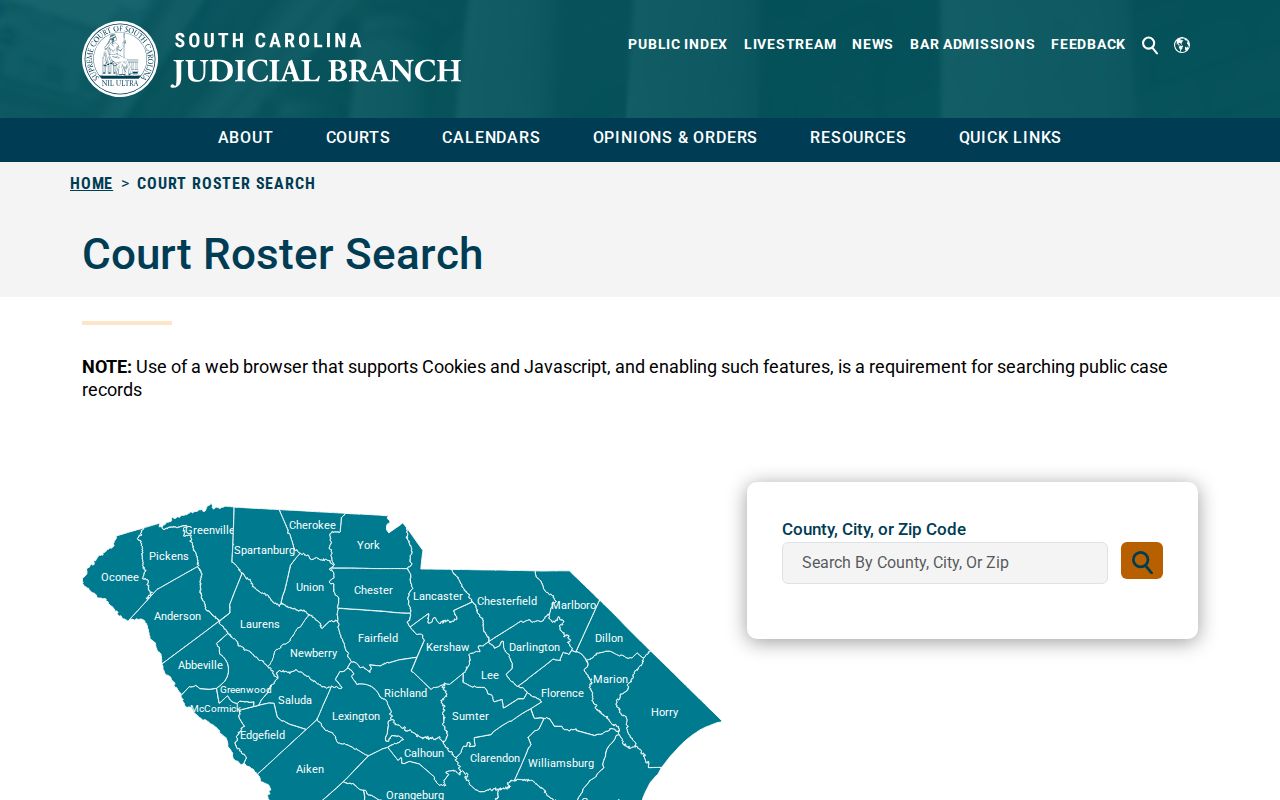
Each tool has its own job. The court roster tracks the charge; the booking portal tracks the person in custody.
South Carolina Busted Roster Map
The statewide sweep found a patchwork, not a central booking feed. County portals use different vendors and windows. Some show current custody; some add recent bookings or releases; some offer a phone, records-request, or in-person route instead. A roster’s missing photo may mean the county does not publish it, the view is delayed, or that entry has no image. It should not be filled with a private gallery.
| Observed county route | Examples from the research | What to keep in mind |
|---|---|---|
| Searchable official portal or roster | Aiken, Anderson, Beaufort, Berkeley, Charleston, Chester, Chesterfield, Colleton, Darlington, Dorchester, Florence, Georgetown, Greenville, Greenwood, Horry, Jasper, Kershaw, Lancaster, Laurens, Lexington, Marion, Newberry, Oconee, Pickens, Richland, Spartanburg, Sumter, Union, York, and Lee through the regional Sumter detention portal. | Search fields, current/release windows, image display, and update timing vary by county. Check the live official page. |
| No verified current public web roster | Abbeville, Allendale, Bamberg, Barnwell, Calhoun, Cherokee, Clarendon, Dillon, Edgefield, Fairfield, Hampton, Marlboro, McCormick, Orangeburg, Saluda, and Williamsburg. | This is a finding about the reviewed public web surface, not proof that the county has no records or photos. Contact the custodian. |
| Other official status routes | SC VINE, county records units, detention-center desks, court rosters, and agency FOIA offices. | These routes answer different questions; not every route shows a mugshot. |
Urban and rural counties follow the same law here. The split is about access, not rules. Bigger systems tend to expose structured portals, while some counties lean on a phone, records, or VINE route. Even a photo-rich roster is not a case history. Florence County's official inmate search shows the pattern well, splitting current custody from released-inmate views without a person's image on the landing screen. Rely on the live page for current details and read the agency's scope notice.
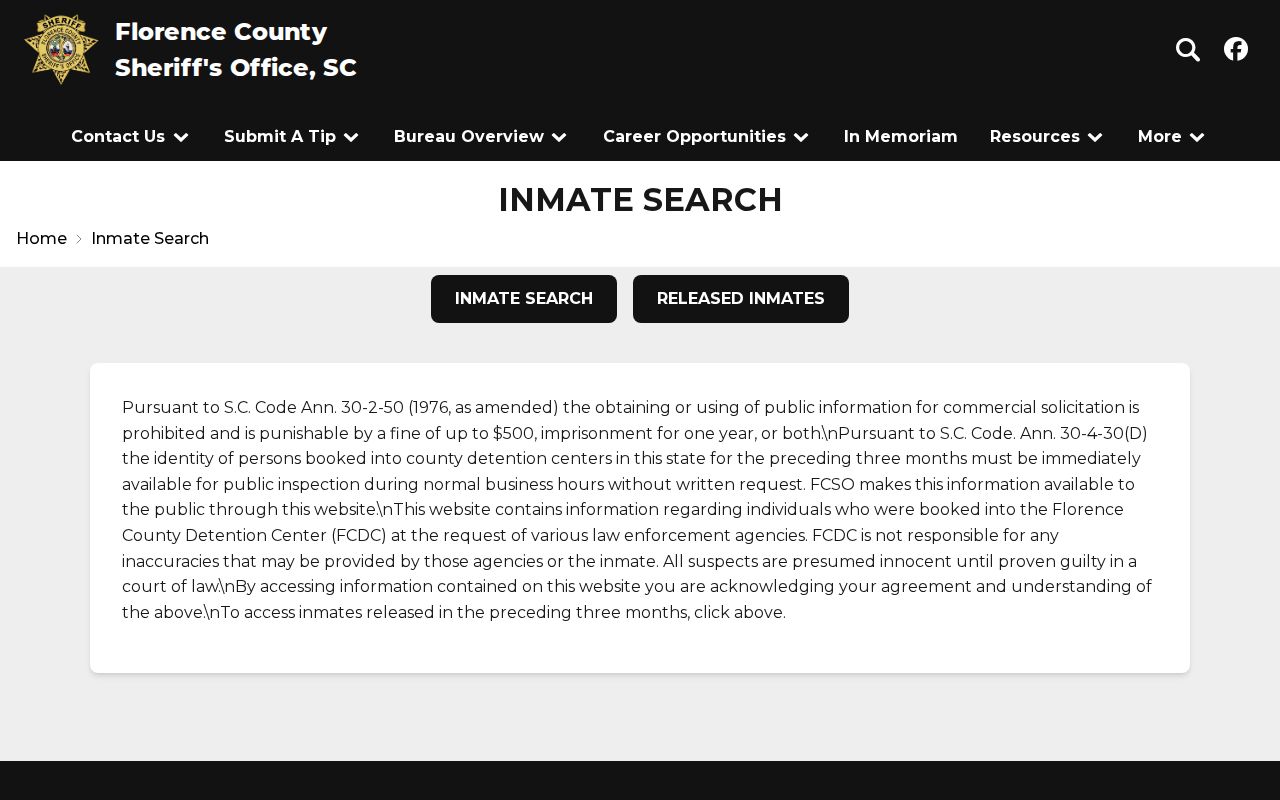
Think of a search landing page as a route map. It is not a result. It says nothing about any person's custody status. Lexington County's official portal is a second example. It publishes with a built-in delay and its own disclaimer. If the timing window is unclear, treat a blank result as a maybe rather than an answer.
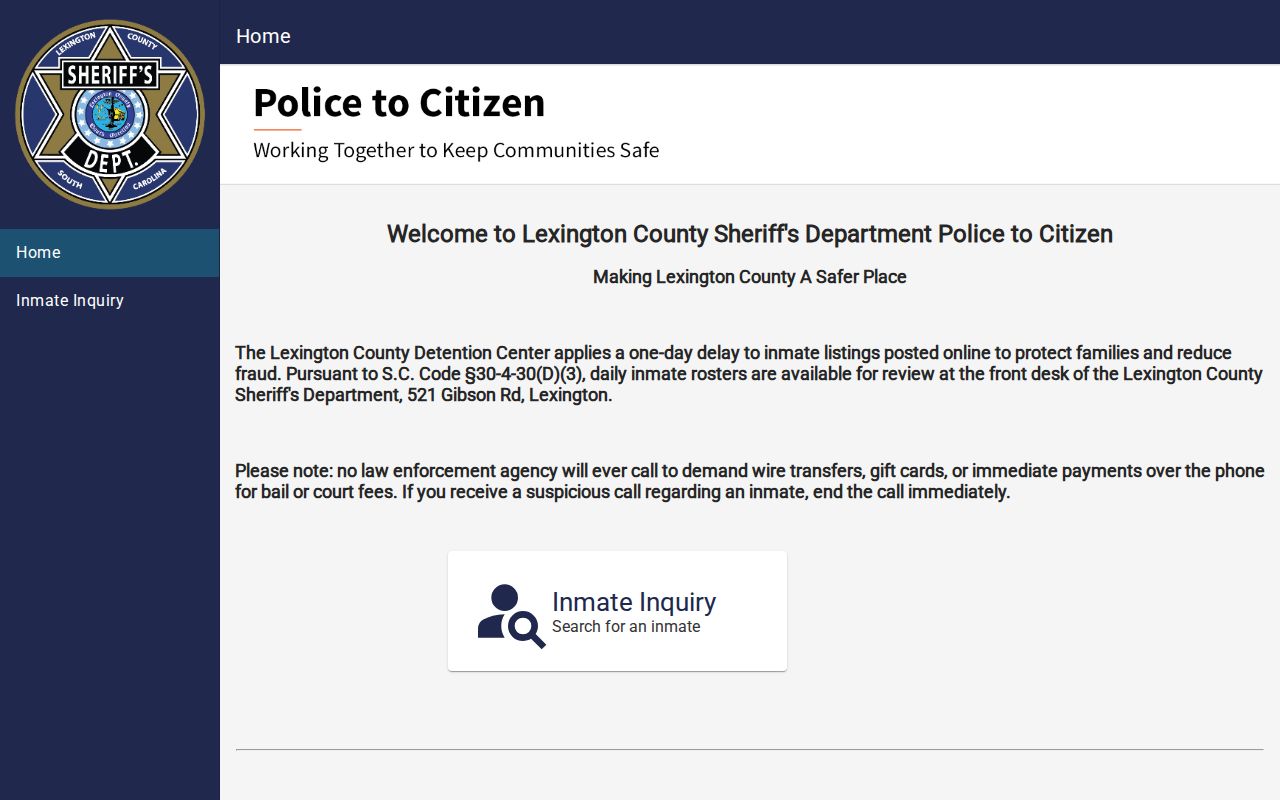
Lexington proves a county can publish on a deliberate lag. Its screen is not an instant alert. Other counties pick their own windows. Chesterfield exposes current plus 24-hour and 7-day admit views. Dorchester adds current, 24-hour, 7-day, and custom admission or release views. Newberry carries a released-last-90-days route, and Florence keeps a separate released-inmate view. These screens are agency choices, not one shared state schedule. No common weekend surge or statewide update cadence exists. Check each portal's date labels instead of assuming every county refreshes together.
Note: A county portal is an access window set by that county, not a promise that every booking or photo remains online.
South Carolina Busted Booking Alerts
SC VINE tracks status changes across participating detention, SCDC, and supervision systems. A victim or authorized user can use it to monitor a custody change. It is not a booking-photo archive, a docket, or a universal roster. Ask the jail for an image or booking record. Ask the court for the case result. County apps are just as uneven. York's official app listing advertises inmate search, wanted information, alerts, and tips. Other county apps work mainly as news or tip channels. Confirm what an app does. Do this before treating an alert as a booking notice. Some counties have no app at all. Photos are never guaranteed. For a release check, read the date and custody label in each source.
SCDC Offender Photos
SCDC stands for the South Carolina Department of Corrections. Its public locator shows photographs. It also shows public information for people sentenced to and incarcerated in SCDC as of midnight the prior day. Plenty of people fall outside that net. The locator excludes anyone released from SCDC. It also leaves out anyone serving a county-detention sentence, people on probation or parole, juveniles housed with the agency, and current SCDC fugitives. Use it for state prisoners, not fresh arrests. Search by name, SCDC number, State Identification number, or a phonetic match. Compare more than a name before deciding a profile fits. The agency does not promise the photo dates to the arrest. It follows no fixed replacement schedule. The SCDC search landing screen is the official starting point for a sentenced state prisoner. A profile and photo appear only when the person fits the locator's defined population.
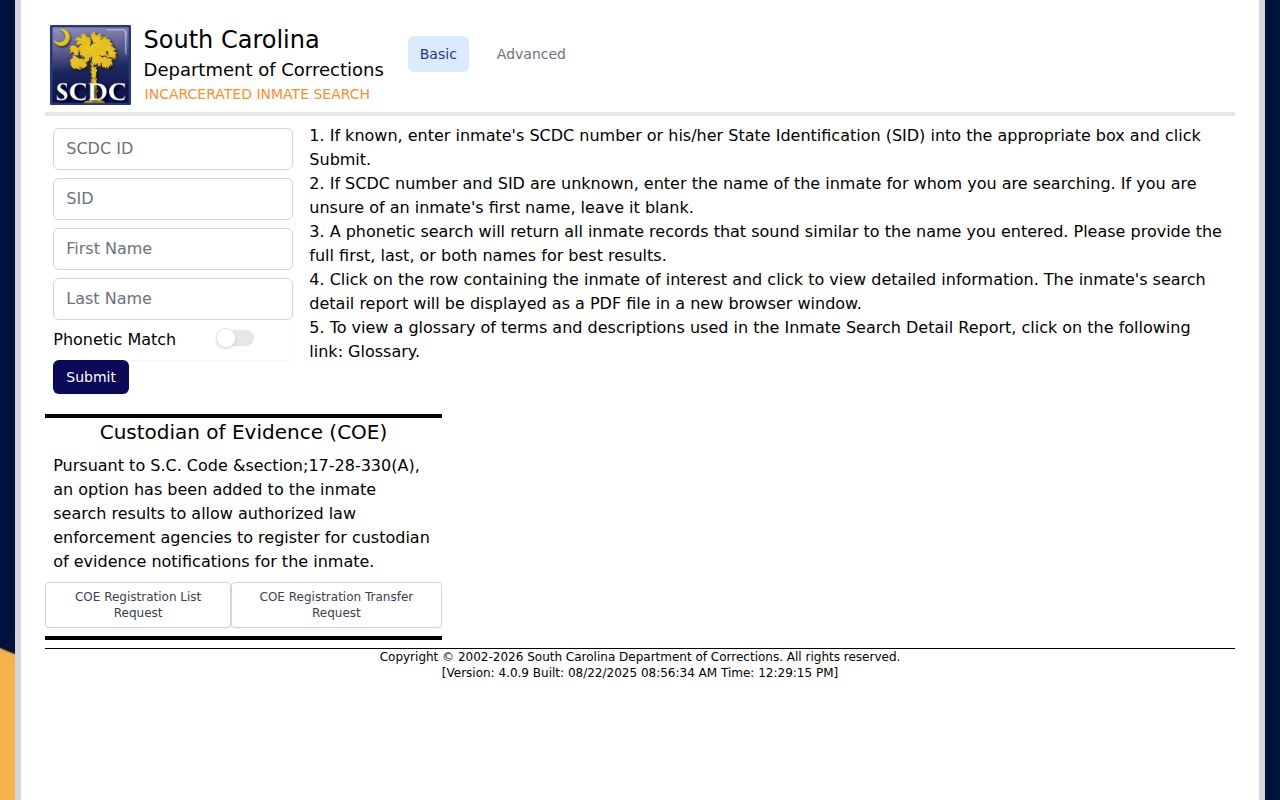
SCDC's landing screen searches the agency's defined prison population only. It won't answer a county arrest question. It is no help for a fugitive alert either. Someone released from SCDC drops out of this current-incarcerated search, so an old case may take a targeted SCDC records request, a court record, or another historical source. Booking and release questions belong with the county that held the person.
Busted in South Carolina: Wanted Checks
A wanted notice and a booking photo answer different questions. The SCDPPPS Most Wanted list tracks people sought over supervision matters. SCDC Criminal Investigations posts fugitive details on escaped inmates. SLED alerts, sheriff notices, and the U.S. Marshals Service each carry their own scope. None adds up to a full statewide arrest feed. A name missing from one list proves nothing about warrants.
For a specific concern, contact the relevant sheriff or court directly. Ask about the warrant and the safe way to resolve it. A court roster can locate a case, but it is no universal warrant-clearance tool. Never approach anyone on a wanted list. Send tips to the listed law-enforcement agency, or call 911 in an emergency. The statewide wanted-list page lays out the official lists and the tip routes for each.
Note: A fugitive list may change without notice, so verify its status with the agency before relying on a saved or shared copy.
Busted, Released, or Sentenced
One word covers many custody stages. A mugshot may show booking or a later point. Match the source to your question, then check a court file for the outcome.
| Stage | Likely source | What it can answer |
|---|---|---|
| New arrest or county custody | Arresting agency and county detention roster or booking feed | Whether the county’s current or recent view shows an intake, charge label, or image. |
| Released from county custody | County release view or targeted public-record request | Whether a past booking record remains accessible. Release alone does not show a dismissal or conviction. |
| Case in court | South Carolina Judicial Branch roster or clerk record | Hearings and disposition information available through that court route. |
| Sentenced to state prison | SCDC public inmate search | Public profile and photo for people currently within SCDC’s stated population. |
| Federal or immigration custody | BOP locator or ICE Online Detainee Locator | Federal custody information under those systems’ rules; BOP does not publish booking photos. |
Here is the chain in plain terms. A person is arrested and booked. They appear on a roster or feed if the county publishes one. Then a court case follows, ending in release, a sentence, dismissal, or another result. A state prison sentence moves the photo search to SCDC. Even so, the county booking photo stays a county image.
Federal and ICE Custody
The Federal Bureau of Prisons locator covers federal inmates from 1982 forward. Search it by name or register number. It shows public custody fields but no booking photographs. Keep in mind it is not a South Carolina county roster. The ICE Online Detainee Locator works differently. It requires an exact A-number and country of birth. Exact first and last names plus country of birth also work, with date of birth optional. It covers current ICE custody and certain CBP situations. But it cannot establish immigration status, a case result, or a South Carolina arrest photo.
Unofficial South Carolina Mugshot Pages
Private arrest pages can leave out counties, court outcomes, or dates. Treat them as leads only. Check the public agency and court source first. None of them is the state's complete roster. RecentlyBooked's South Carolina page offers a rolling 30-day view across a subset of counties. Its publisher-stated correction route is free and asks for the listing URL plus supporting records, though that window is no official refresh guarantee.
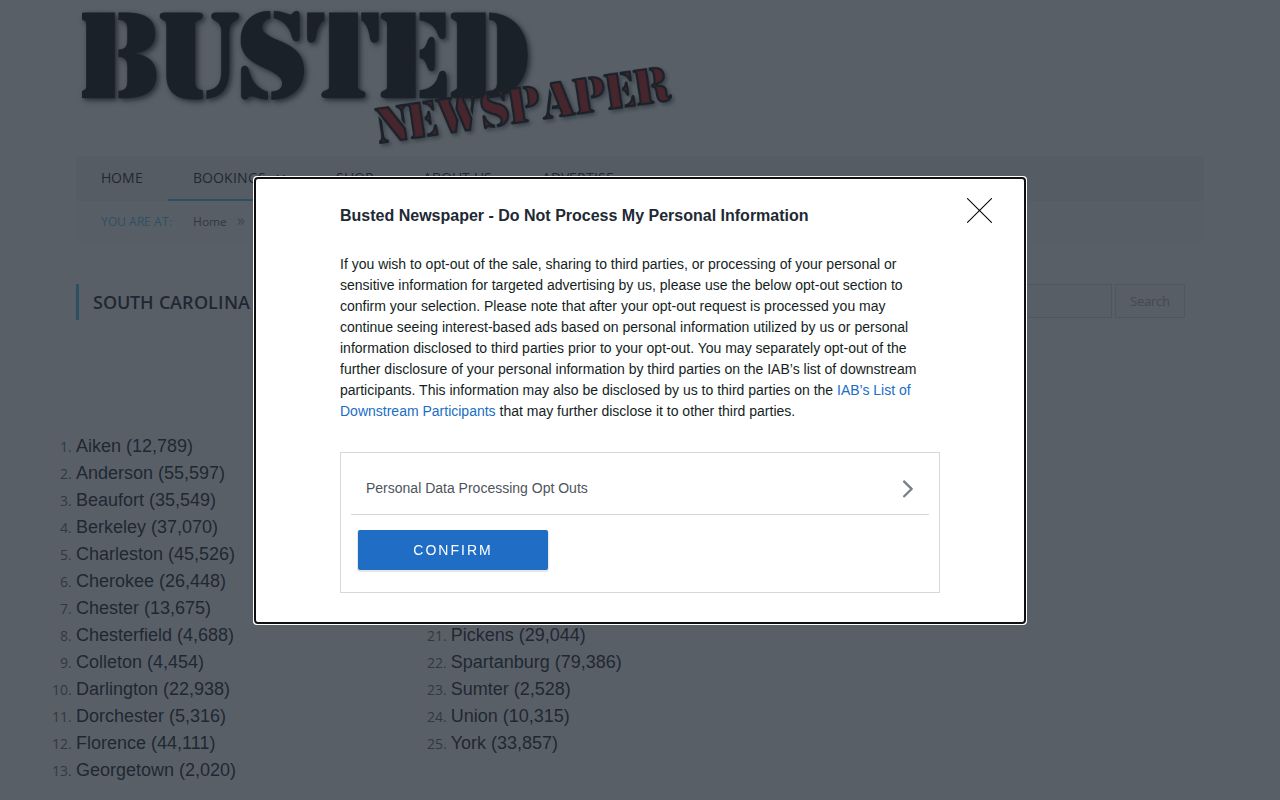
The page shows the publisher's list. It is not a live jail status report. BustedNewspaper's South Carolina directory has uneven county coverage and publishes a no-fee route for supported correction requests. Its state page and policy are publisher statements, not a complete roster or a state finding.
Mugshots.com's South Carolina directory sorts its material through a publisher's category interface. That is not a custody report. It is only a listing. It holds county links and legacy material, with qualifying updates free under its policy. Arrests.org shows recent cards for a county subset. It posts no site-wide free correction policy. Mugshots.zone links changing county pages. Statewide coverage and a current no-fee route are not settled there either. Confirm every listing with the agency and court. ABC News 4, Live 5 News, The Post and Courier, The State, WIS, WLTX, WYFF 4, FOX Carolina, WRDW, and WMBF publish regional or statewide event reports. Some stories carry agency photos. These editorial pieces are not rosters. Request factual updates from the newsroom using the official case result, since the newsrooms offer no blanket mugshot opt-out.
Booking and Court Terms
These short definitions keep the photo, custody entry, and case result separate.
- Booking
- The intake process after an arrest, when the jail records the person and custody event.
- Disposition
- The court’s recorded result, such as dismissal, plea, acquittal, or sentence.
- Expungement
- A legal process that can require eligible records to be destroyed or sealed under the statute and order.
Old images vanish from current systems. The South Carolina Department of Archives and History offers a separate historical research route. Its catalog promises no statewide mugshot collection. The Old Mugshots page explains how to trace a record by era and creating agency.