
South Carolina SCDC Mugshots and Custody Scope
SCDC stands for the South Carolina Department of Corrections. It runs the state-prison system. The agency's public search shows photos and public details for people who are both sentenced and incarcerated in SCDC custody. Data reflects midnight the preceding day. That gives the locator a daily reference point, not a live booking feed. A county arrest, jail intake, a prison sentence, and release are separate events kept by different custodians.
The exclusions matter. The search omits anyone released from SCDC. It also omits people serving county detention sentences, anyone on probation, parole, or another community-supervision status, juvenile offenders housed with the agency, and current SCDC fugitives. So a person can be missing from the page despite a South Carolina arrest or an earlier prison term. A hit means one thing: the person fell inside the stated public population when the data was prepared. It says nothing about every police contact. That fuller history lives with other agencies.
SCDC photos are not county booking photos. A booking image comes from local intake. An SCDC photo belongs to a state-prison offender profile. The state system never promises the picture was taken on the arrest date. The agency gives no schedule for refreshing images. Don't read freshness into a photo just because it sits beside a current custody profile. Treat the image as an agency record of the prison system and nothing more.
The official SCDC search disclaimer defines who appears in the locator and states its prior-midnight timing.
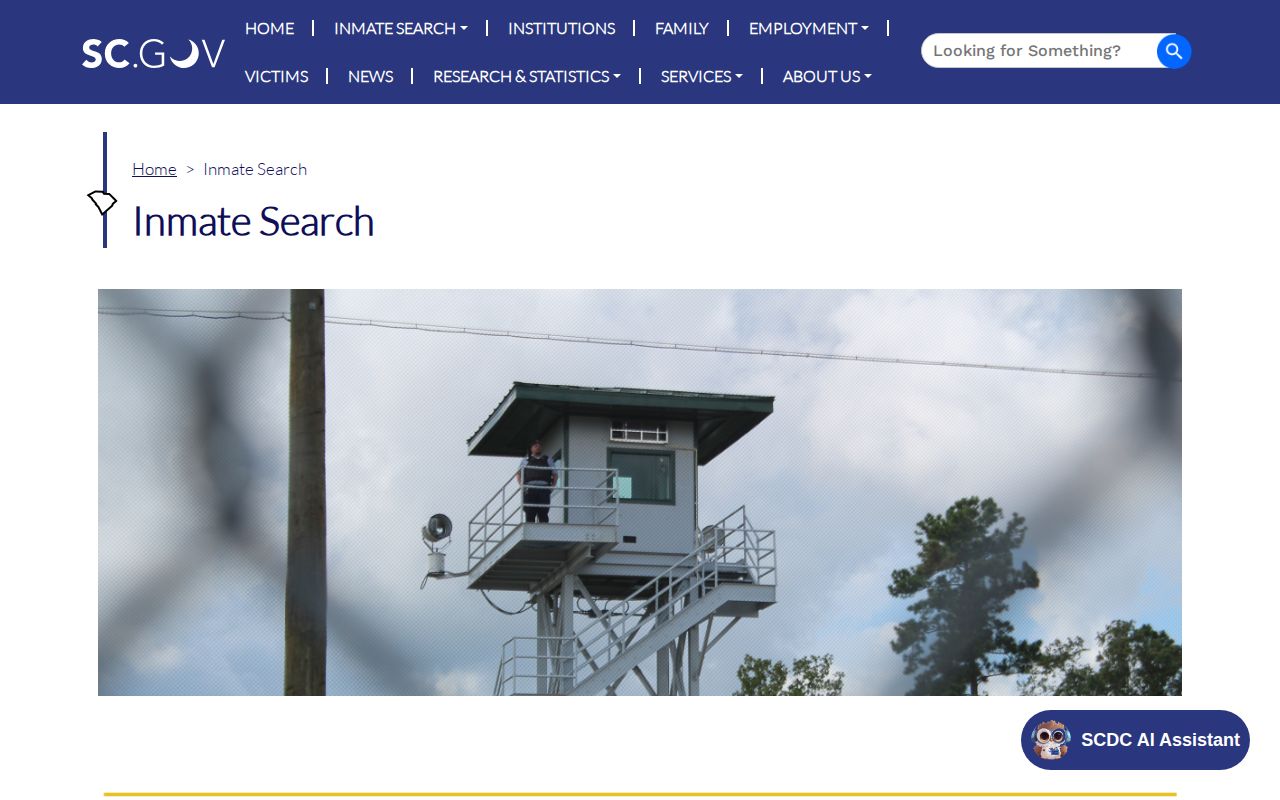
It shows the agency's search rules. No individual profile appears. Check the live disclaimer before relying on any result, since the agency can revise its page or its service scope at any time.
How to Search the SCDC Offender Locator
The SCDC public offender search is where state-prison lookups begin. It accepts several options. You can enter a full name, an SCDC number, a State Identification number (SID), or run a phonetic name search that catches approximate spellings. An exact identifier helps when common names collide. The tool covers only SCDC's current public population, so a missing name should send you to the correct other agency rather than to a guess that no record exists. Assuming otherwise wastes time.
The official blank SCDC search screen shows the state-prison locator without displaying a person’s face.
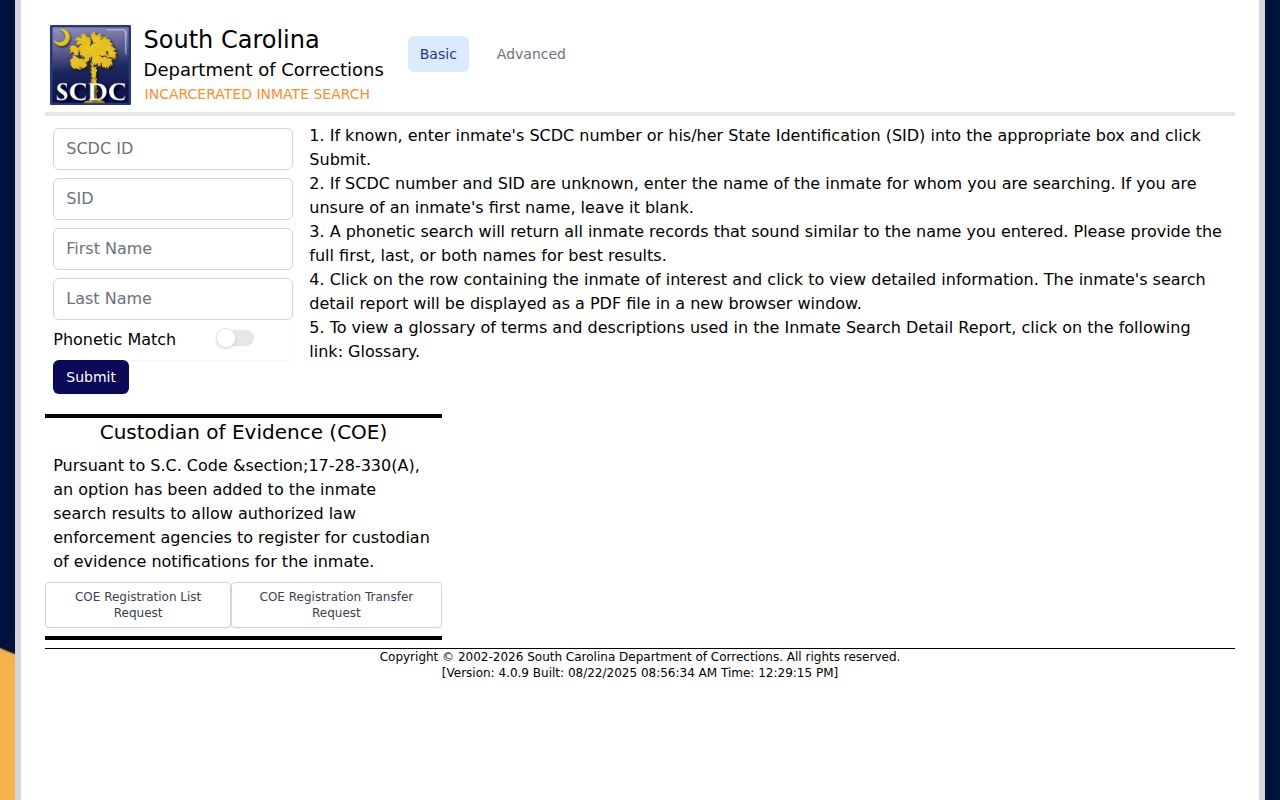
This picture is an interface example only. Go to the live agency system for current custody information, since screenshots, copied results, and search-engine previews all go stale.
- Open the live SCDC disclaimer first and review its population limits. Then follow the official link to the public locator.
- Enter a known SCDC number or SID when available. If searching by name, try the exact spelling and then the phonetic option for a likely spelling variation.
- Open a likely profile and compare the public identifiers shown. A shared name by itself is not enough to identify a person.
- Record the date you searched and keep the “as of midnight the previous day” qualification with any notes you make.
- If the profile is absent, first decide whether the person is outside SCDC’s stated scope. For a county arrest, released state prisoner, or supervision status, use the appropriate county, court, or supervision source.
Interfaces change. Access depends on the live service, your browser, and the identifying details you hold. A phonetic match is a lead, not an identity. Shared names are common. When several people carry the same name, compare the exact agency number and the profile details before settling on one. Don't lift a face or name from a third-party page. Confirm against the official record first.
Start with the right question. "Is this person currently in an SCDC prison?" fits the locator's scope. "Was this person booked by a county yesterday?" does not. "Was this person once incarcerated by SCDC?" may take a records request if the person has already been released, and mixing these questions pushes a valid search toward answers it was never built to give.
What an SCDC Offender Profile Can Establish
A matching SCDC result establishes a few things clearly. It places the person in the agency's current sentenced-and-incarcerated population, with public inmate information and a photograph on the page. It also confirms the search works by name, SCDC number, SID, or phonetic spelling. Profile fields vary. No single list of fields appears for every person, since the display depends on the live record and agency choices. Trust only what the profile actually shows.
| Search or profile element | What the source supports | How to read it |
|---|---|---|
| Name search | The interface allows a name query. | Common names can return more than one possible person; compare identifiers. |
| SCDC number | A known Department of Corrections number is a search option. | Use it when available to distinguish a profile from another person with the same name. |
| SID number | A State Identification number is an accepted search field. | It is an identifier, not a case disposition or a guarantee that every related record is in the profile. |
| Phonetic search | The locator supports an approximate name search. | It may help with spelling, but a similar-sounding name is not proof of identity. |
| Photo and public information | The agency says the search displays photographs and public information for its covered population. | The page does not state that every profile has a fresh photo or a uniform set of fields. |
| Search date and scope | Information is described as of midnight the prior day. | Preserve the date and scope when recording a result; later changes may not appear yet. |
Skip the private directories when a fact is missing. A third-party site may carry an outdated number, miss a later release, or pair the wrong picture with a name. Blank fields prove nothing either way. Ask SCDC directly what record it maintains when the question concerns a document rather than the public locator. The agency can state what it holds.
A profile is not a court file. It is one piece, not a full chronology of arrests, charges, hearings, and appeals. Need to know what a court did with a charge? Pull the court record and read its event labels. The Court Roster Search links to county and city routes, including separate Charleston and Greenville paths, and the state trial-court portal is another option. Some court searches need scripts and cookies enabled. An empty roster proves nothing.
SCDC Photo Timing and Former Inmates
The locator covers current sentenced SCDC inmates, with information current to midnight the previous day. Photo timing is another matter. The agency says nothing about when a picture is taken or how often it is replaced. It also does not say whether an image is refreshed after an appearance change or how long it lingers in other public systems. Never call a profile photo a fresh booking shot. Not unless the originating agency supplies that date. A search timestamp and an image's creation date are two different facts.
Release removes a person from the public search entirely. That limit holds even for someone who once had an SCDC number or public profile. County detention centers fall outside the tool. People on community supervision are omitted too. Juveniles housed with the agency and current SCDC fugitives are also left out. An empty result is not a statewide no-record answer. The blank may reflect an agency boundary, a name variation, a data timing issue, or information the tool never displays.
For an old state-prison term, ask the agency whether it holds the record or image and whether any access limit applies. A fresh local arrest belongs to the county that booked the person. Probation or parole? Go to the supervision agency's records or public notices. An SCDC escape or fugitive matter calls for the criminal-investigations contact route. A missing profile is not a safety signal.
The SCDC Criminal Investigations page provides the relevant agency route for fugitive and escape information.
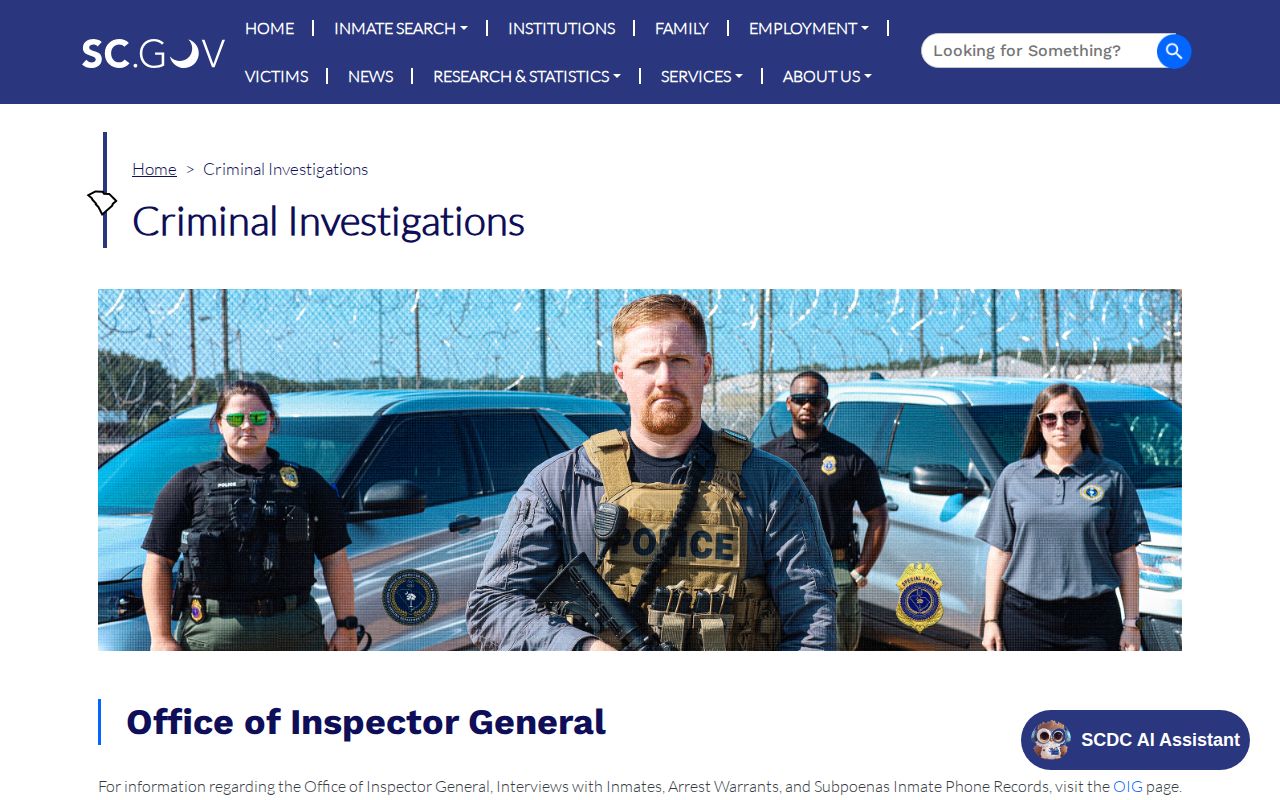
The agency page shows a contact and safety route, not a wanted poster. Follow the live instructions and send information to law enforcement instead of approaching a person.
SCDC Profiles Versus County Booking Records
Custody status shifts as a case moves. It can run from local booking to court to possible state prison. The SCDC locator answers one narrow question: who is in state prison now. County records cover local intake and detention. Courts show filed events and dispositions. A status tool helps track movement. But it replaces neither a booking photo nor a docket. Match the system to the record and the time period.
| Record source | Typical scope | Question it can answer | Limit |
|---|---|---|---|
| County sheriff or detention portal | Local booking, current custody, or a county-defined recent period | Did the county publish an intake or custody entry? | Windows, filters, and photo publication vary by county; release may remove a person from the live view. |
| SCDC public offender search | People sentenced to and currently incarcerated in SCDC | Does the state-prison locator show a covered current offender profile? | It excludes county detention, released people, supervision, juveniles, and current SCDC fugitives. |
| South Carolina Court Roster Search | County and city court roster links and case lookup routes | Where can a reader look for a hearing or court event? | It is not a statewide booking-photo feed or universal warrant clearance service. |
| SC VINE | Status and notifications for participating systems | Has a participating custody status changed? | It is not a photo archive, complete docket, or one feed for every county. |
The South Carolina Court Roster Search provides the state’s county and city court lookup routes.
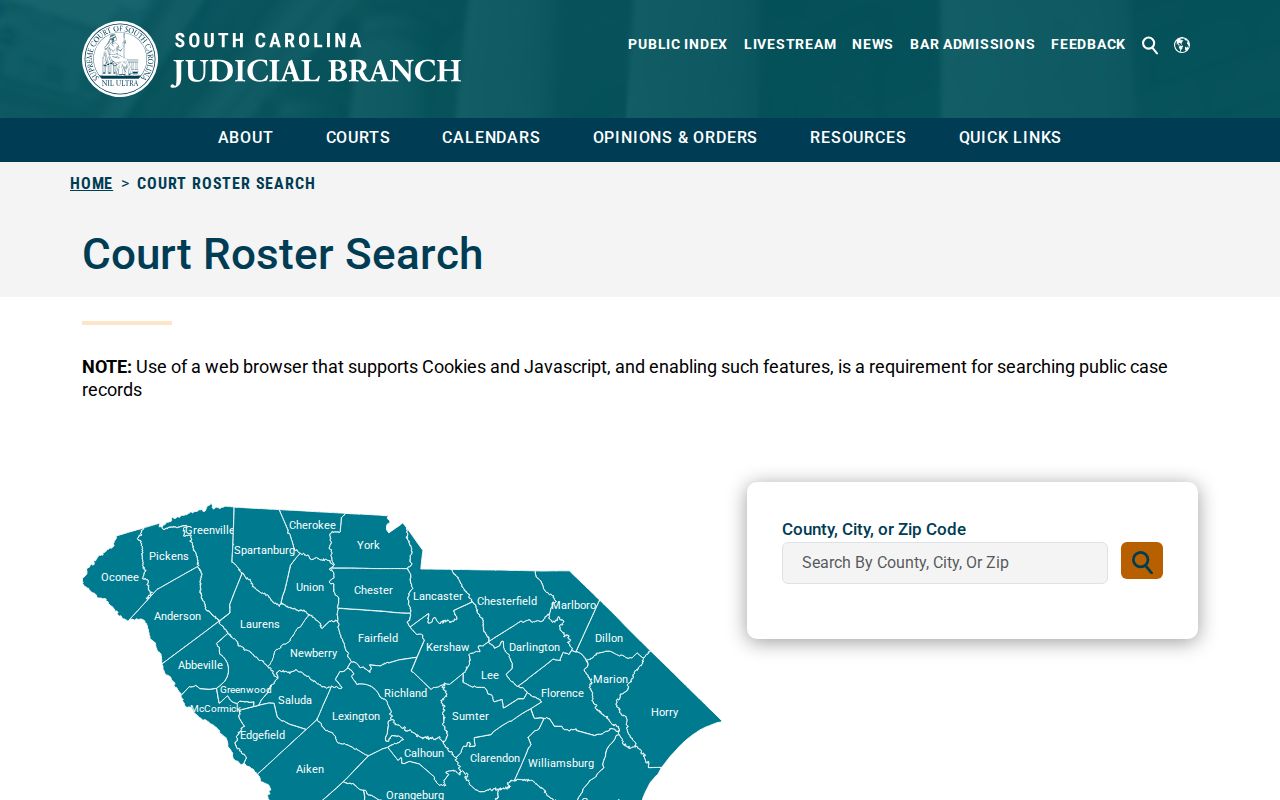
The landing page illustrates a separate case-search layer. Links and technical requirements there can change. Open the official court site directly and follow its current instructions.
For local booking sources, start with the South Carolina County Directory and pick the county that made the arrest or held the person. Someone released and off a live roster? Request the booking record from the originating custodian. The county and the arresting municipality can differ, and one city may send arrests to a county detention system. A statewide site cannot assume which local agency made or keeps a record.
Request SCDC Records and Photos
The public locator is not the only route. Identify the item narrowly and send a request to SCDC's FOIA contact. Records outside the locator go to FOIA@doc.sc.gov. Say exactly what you want. It might be a photograph, a commitment or release record, or another named document. Add an SCDC number or SID when known. A date range helps too. Hold back sensitive identity papers. Give them only if the agency asks.
South Carolina FOIA covers nonexempt public records held by public bodies. A photograph can fall within that broad definition. The law allows exemptions too. Agencies may charge actual, reasonable search, retrieval, redaction, and copying costs. A deposit of up to one quarter of an estimate may be required. FOIA cannot force SCDC to create a record it does not keep. An open investigation, privacy rule, or juvenile restriction can block release. Ask for an estimate and the legal basis if an item is withheld.
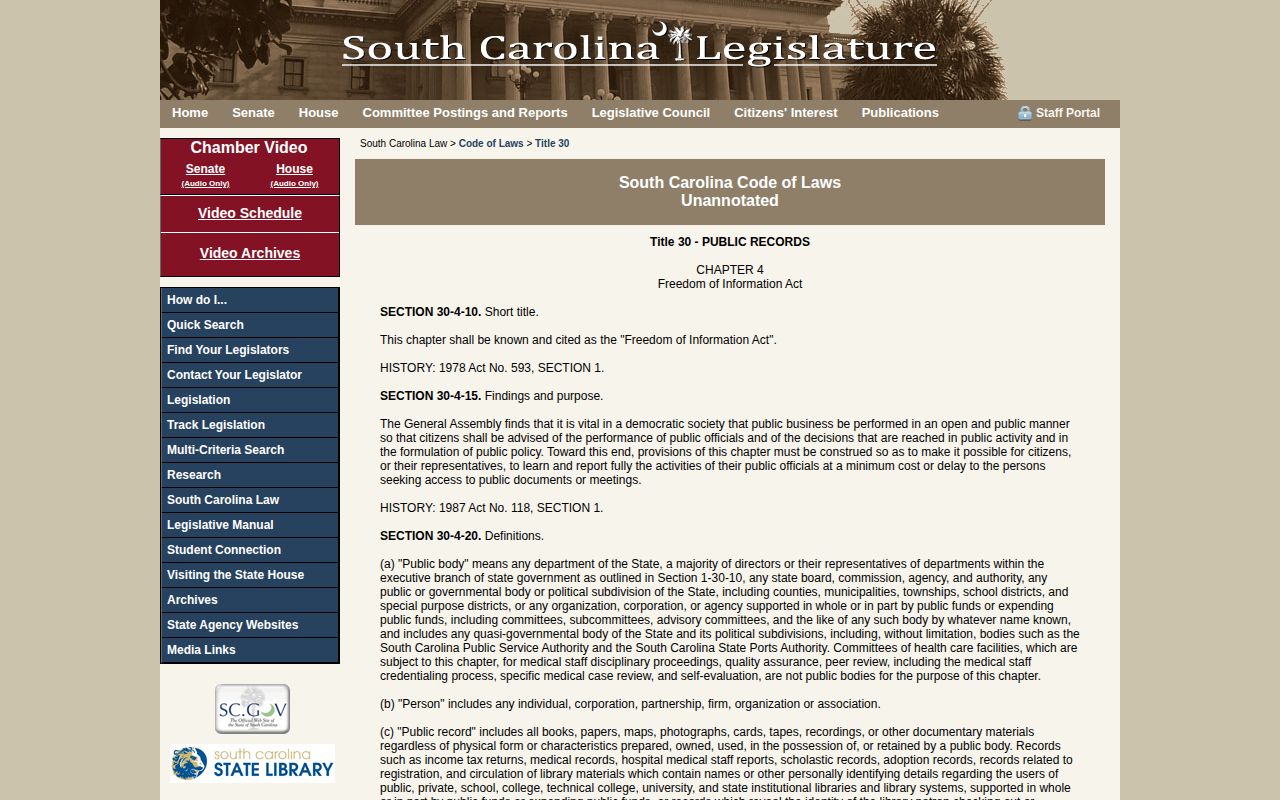
The South Carolina FOIA statute sets the public-record definition, request duties, cost rules, and exemptions.
A good request starts with the right target. Name the item you want and the office most likely to hold it. That lets the agency search the correct system instead of guessing. Saying simply "everything you have on this person" rarely helps. One office may hold only part of the file. SCDC may hold the commitment record. That does not mean it also holds the county booking photo. Agencies create records, and the creator keeps them unless a retention schedule says otherwise. So state plainly what you seek. It might be an SCDC profile photograph, a county booking image, a commitment document, or a release record.
South Carolina FOIA sets the clocks. An agency generally makes its determination within 10 business days. For a record more than 24 months old, the window stretches to 20 business days. Once access is granted, production follows a set clock. The deadline is 30 calendar days from that determination. Older records get 35 calendar days, subject to the deposit rule. These are statutory processing periods only. They do not promise SCDC will release the record, nor that a given search takes that long.
Narrow requests move faster. Give a short date range and one record type. A sweep of a person's entire history can span several offices and be too broad to match a single record. Keep your original wording, too. Save any written scope clarification along with the agency response.
- Confirm that SCDC is likely to hold the record. A local booking photo usually belongs with the arresting or detention agency, not the state-prison locator.
- Describe the record type, approximate date, and subject. Add the SCDC or SID identifier if you have it.
- Email the request to FOIA@doc.sc.gov and ask the office to contact you before incurring estimated fees.
- Keep the response and note any exemption, cost estimate, deposit, or appeal instructions the agency provides.
Spotted an error in the public search? The agency disclaimer points to its Ombudsman route and a toll-free number. Those are the right channels for a locator correction, not the FOIA mailbox. If SCDC says it does not hold the material, press for details. Ask which office created the record. Or ask whether it was transferred or destroyed under a retention schedule.